Business systems
Reduce the steps and risk in routine work
I simplify repetitive operational tasks with focused tools, safer states, and less unnecessary navigation.
Simplify our workflowStaged example; no client data is shown.
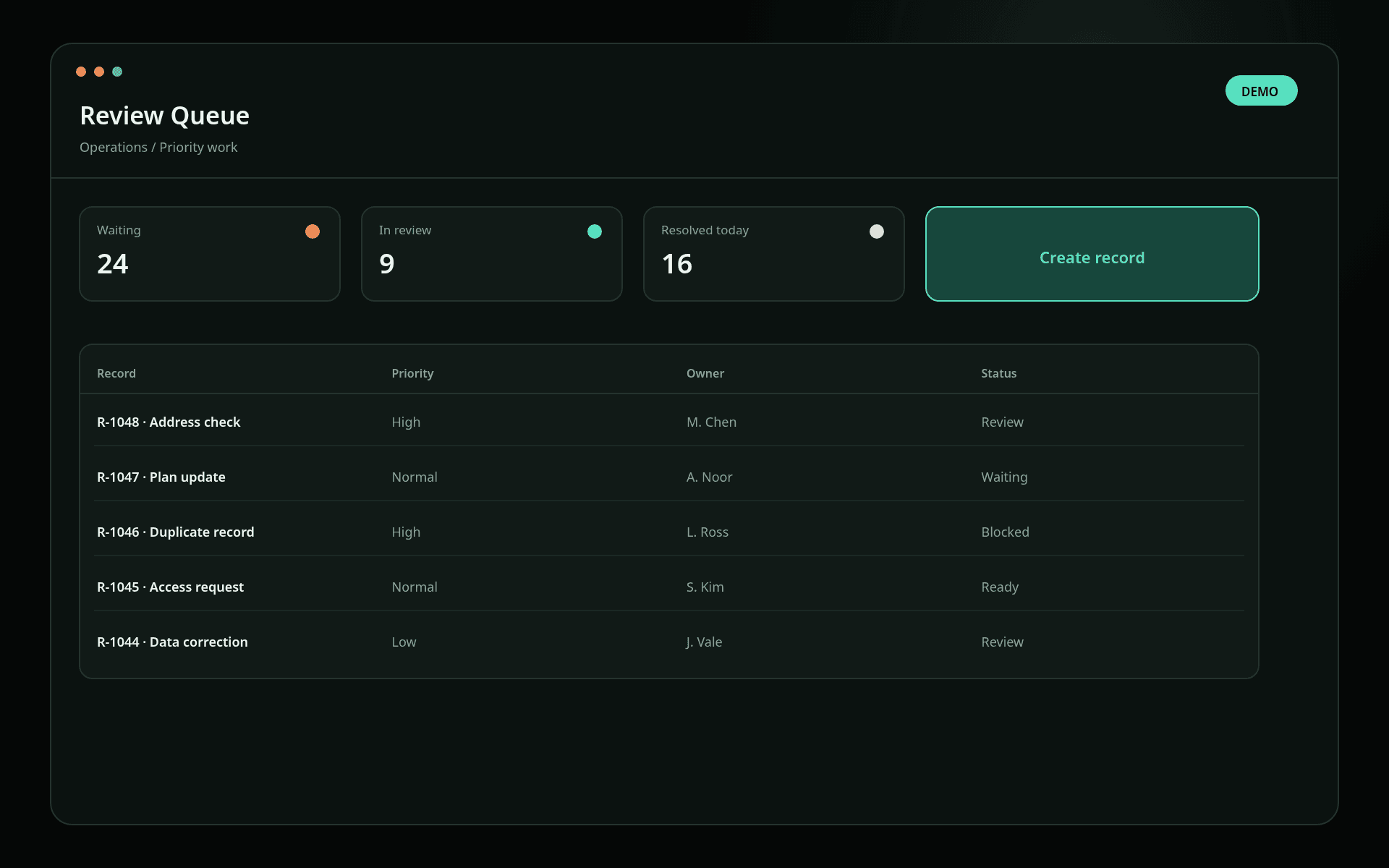
A practical example
See a representative internal tools context without client data or implied results.
What it is
Internal tools support staff workflows such as review, approval, scheduling, data entry, and exception handling.
The problem
Generic software and manual workarounds force staff through unnecessary steps and make errors harder to detect.
Best fit
- operations teams with repeatable workflows
- staff replacing spreadsheet-based work
- organizations improving admin interfaces
What improves
Focused internal tools that reduce repetitive steps, ambiguity, and operational risk.
Main result
Routine work takes fewer steps and makes important exceptions easier to spot.
Clearer experience
People can see the current state, owner, and next action.
Dependable delivery
Operational rules become visible instead of living in spreadsheets and memory.
Possible scope
- workflow and role mapping
- forms, tables, filters, and decision views
- permission-aware interface states
- integration-ready frontend architecture
Before work starts
- Data correctness, authorization, audit trails, and domain rules are enforced behind the frontend.
- Migration, security, and infrastructure receive specialist ownership when required.
How I work
Understand
I clarify the users, business need, constraints, and available evidence.
Shape
I turn that context into a practical structure, prototype, and delivery plan.
Build
I implement the interface in testable slices, checking accessibility and performance.
Ship
I verify agreed flows, document ownership, and prepare a controlled release.
Clear ownership
I lead product thinking, UX, frontend engineering, accessibility, performance, and delivery. Backend, infrastructure, security, content, and domain specialists join when the work needs them. AI supports research, iteration, QA, and documentation; people remain accountable for decisions and release quality.
Common questions
- What work can a custom internal tool simplify?
- Internal tools support staff workflows such as review, approval, scheduling, data entry, and exception handling.
- When is a custom tool more useful than another spreadsheet?
- This service is best suited to operations teams with repeatable workflows, staff replacing spreadsheet-based work, organizations improving admin interfaces.
- What can an internal-tool delivery include?
- A typical scope can include workflow and role mapping, forms, tables, filters, and decision views, permission-aware interface states, integration-ready frontend architecture. The final scope is agreed before work begins.