Business systems
Turn repetitive work into a dependable AI workflow
Whether the workflow is still manual or a first AI automation has hit a wall, I map the real work, automate the repeatable steps, and engineer the integrations, safeguards, and evaluations needed to make it dependable.
Automate or improve our workflowStaged example; no client data is shown.
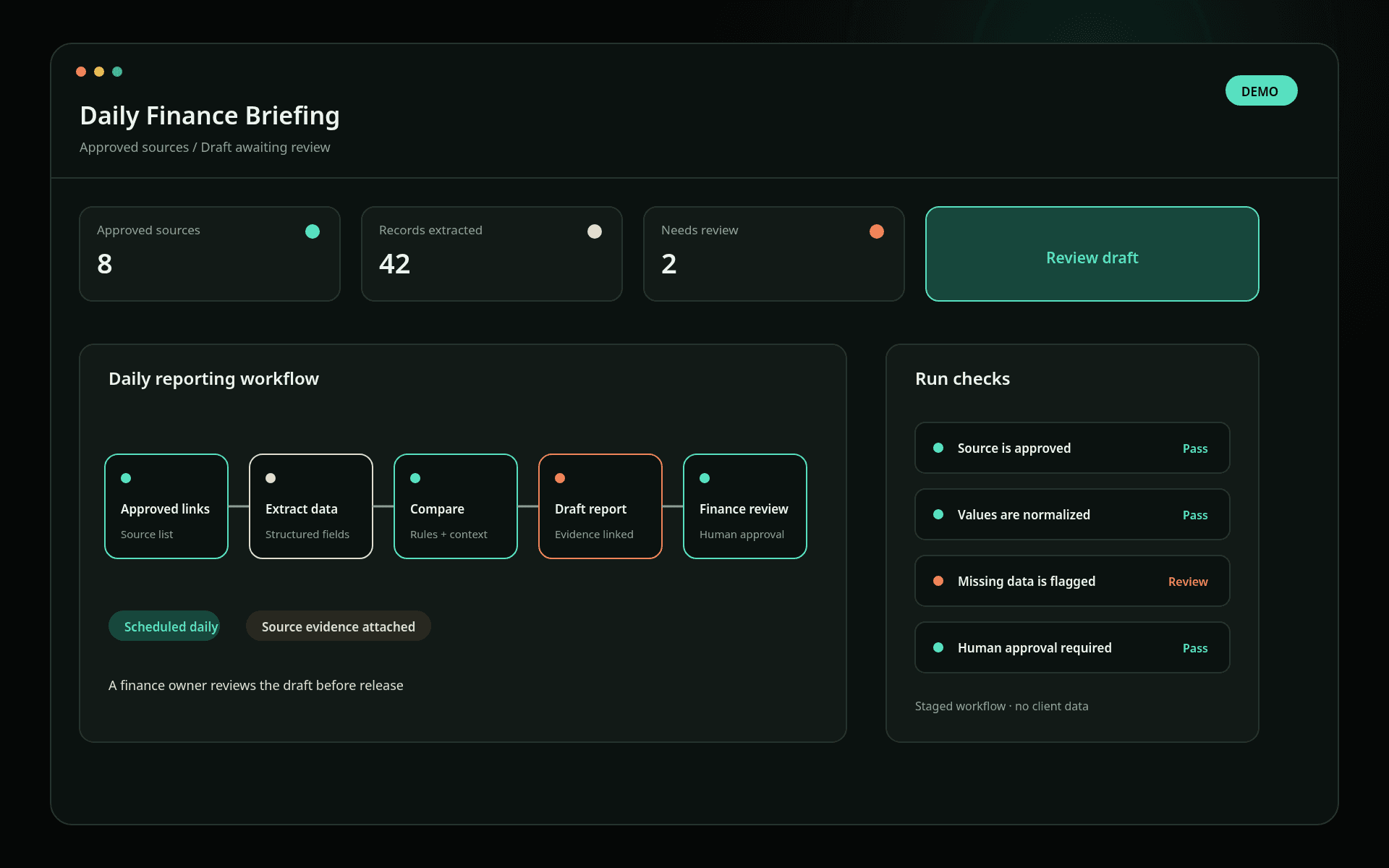
A daily finance reporting agent
A finance team may spend hours each week opening approved documents, extracting and copying figures, analyzing changes, reaching a preliminary conclusion, and entering the result into another application. I can turn those repeatable steps into a reviewable AI workflow that reads approved files, structures the data, drafts the conclusion, and waits for a finance owner to approve the final write. If your team already built a basic version and it has reached its limits, I can diagnose, stabilize, evaluate, and extend it. A tool such as n8n can orchestrate the steps. The aim is to give the team back time without handing source selection or final financial judgment to the agent.
What it is
AI workflow automation turns a repeatable manual process into a reviewable sequence of approved inputs, agent actions, tool integrations, checks, and human decisions. Improvement work starts from an existing version and strengthens what daily use exposes.
The problem
Teams can spend hours opening documents, analyzing information, copying data, reaching a conclusion, and entering the result elsewhere. A basic AI-built version may remove a few steps yet stall on real inputs, context, integrations, exceptions, or safe approval.
Best fit
- teams repeating document analysis and data transfer
- operators with a basic agent that has hit an engineering limit
- workflows that need automation without removing human judgment
What improves
AI workflow automation for repeatable work, plus engineering help when a self-built agent needs to become more dependable.
Main result
Repeated manual steps become a reviewable workflow, and an existing agent gains a tested path to more dependable operation.
Clearer experience
People can see the current state, owner, and next action.
Dependable delivery
Operational rules become visible instead of living in spreadsheets and memory.
Possible scope
- manual-workflow or existing-agent assessment
- approved-document ingestion, extraction, normalization, and structured transfer
- agent, model, tool, and destination integration with context, retries, and recovery
- human approval paths, evaluations, and maintainable handoff
Before work starts
- Inputs, outputs, permissions, evidence, and acceptable failure modes are agreed before automation begins.
- Model providers, platform accounts, production data, business policy, security controls, and final release remain with their owners.
How I work
Map the work
I map the manual process or current agent, approved sources, tools, handoffs, decisions, exceptions, and desired result.
Design the safeguards
I define structured inputs and outputs, permissions, approval gates, recovery paths, representative cases, and observable checks.
Build or improve
I automate the agreed steps or strengthen the existing agent across integrations, context, orchestration, retries, and reporting.
Evaluate and hand over
I compare behavior with the baseline, document limits and ownership, and prepare a maintainable release path.
Clear ownership
I own workflow mapping, the engineering assessment, the agreed automation or agent improvements, and reproducible evaluation. Your team retains ownership of provider accounts, approved sources, production data, business policy, security approval, and final release decisions.
Common questions
- What manual work can an AI workflow automate?
- Good candidates have approved inputs, repeatable steps, explicit outputs, and reviewable exceptions. That can include reading documents, extracting and normalizing values, comparing changes, drafting a conclusion, and preparing data for another application.
- Can you improve an AI automation we built ourselves?
- Yes. AI-assisted tools can help your team build a useful first version. When it hits limits in tool calls, context, orchestration, retries, evaluation, or maintainability, I reproduce the problem and engineer the missing layer.
- How do you keep an AI workflow dependable and reviewable?
- I define representative cases, validate sources and data, make errors and retries observable, and keep human approval gates for consequential actions. I compare the resulting behavior against the baseline before handoff.